
… and how did an online store lose thousands of dollars because of a single wrong setting?
Email marketing is a huge opportunity for online stores, but if it isn’t set up properly, it costs money while bringing in little revenue. Many businesses believe email marketing works once the newsletters have been “sent” – but what happens if those emails never arrive?
In this case study I show a real example: an online store lost thousands of dollars simply because it worked with a badly configured sending setup. Here I describe how this was fixed, and how you can avoid the same mistake. Amounts were converted from Hungarian forints (HUF) at 335 HUF = 1 USD.
The starting point: when email marketing is just a task to “get done”
At the end of 2024 I visited an online store as a customer. It is a major Hungarian store selling both retail and wholesale. Out of professional curiosity I always look at stores like this more closely, so this time too I subscribed to their newsletter and checked GDPR compliance and other key factors that affect the effectiveness of email marketing.
Even the basic check turned up a number of problems and gaps, so I contacted the owner to share what I had found. He told me he no longer handled operational tasks directly, and that a member of the marketing team managed the email campaigns – with more of a “let’s get it over with” attitude. Which is completely understandable, since she had many other tasks to do…
Fortunately, the business was open to change, and we soon started working together, with the goal of completely rethinking the email marketing system.
Auditing the email marketing system: everything looks fine, but the numbers say otherwise
The store ran on UNAS (a Hungarian ecommerce platform), and used MailerLite for email marketing. The basic technical settings – data sync, analytics and DNS records – were in order, which at first glance suggested a proper sending infrastructure.
The database had between 75,000 and 85,000 subscribers, a significant customer base. Its composition was also quite complex, since the store had been collecting email addresses for 15 years, and before UNAS it had stored data in Shopify, and before that in WooCommerce.
The first email campaign was sent from MailerLite in June 2024. But when I reviewed the annual statistics, a shocking problem came to light:
In 2024 a total of 4,000,000 emails were sent, but they led to only 6 purchases, worth $405 in total.
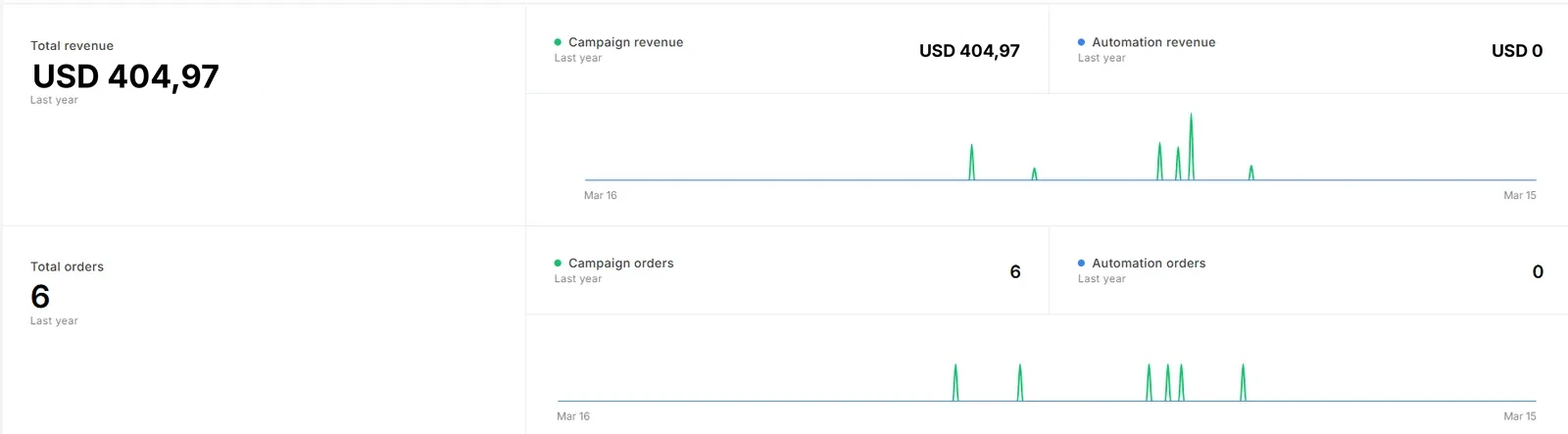
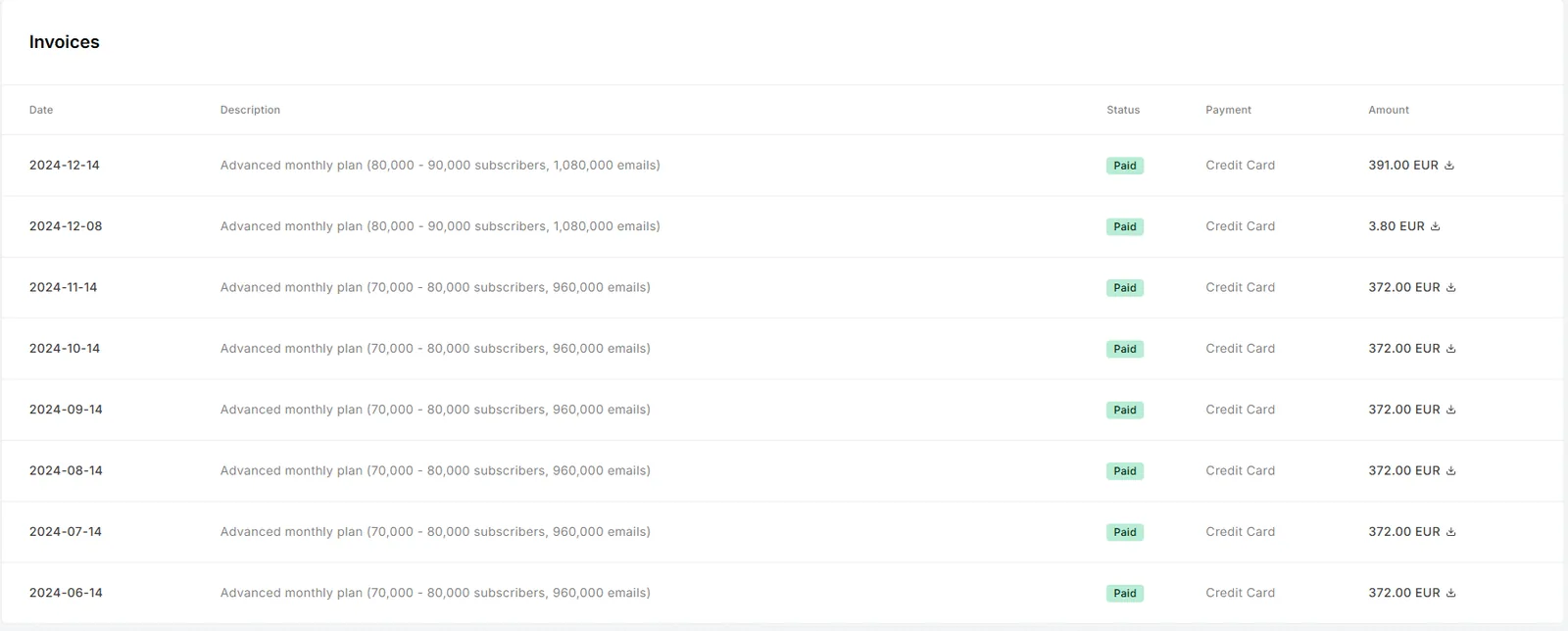
That is an extremely low conversion, especially given that the MailerLite subscription cost €2,627 (about $3,134). In other words, email marketing cost more than seven times as much as the revenue it generated!
Further checks showed that no automated email flows had been set up at all, so there was no:
- Welcome email series for new subscribers
- Abandoned cart reminder email
- Post-purchase follow-up campaigns
So email marketing couldn’t work properly, and I had to look deeper into the causes.
Why was email marketing losing so much money?
Several factors caused the problem, but one of the most critical became clear in the very first data analysis. I stepped in in December for some quick firefighting, and analysing the campaign data of the previous months, a serious gap was immediately obvious:
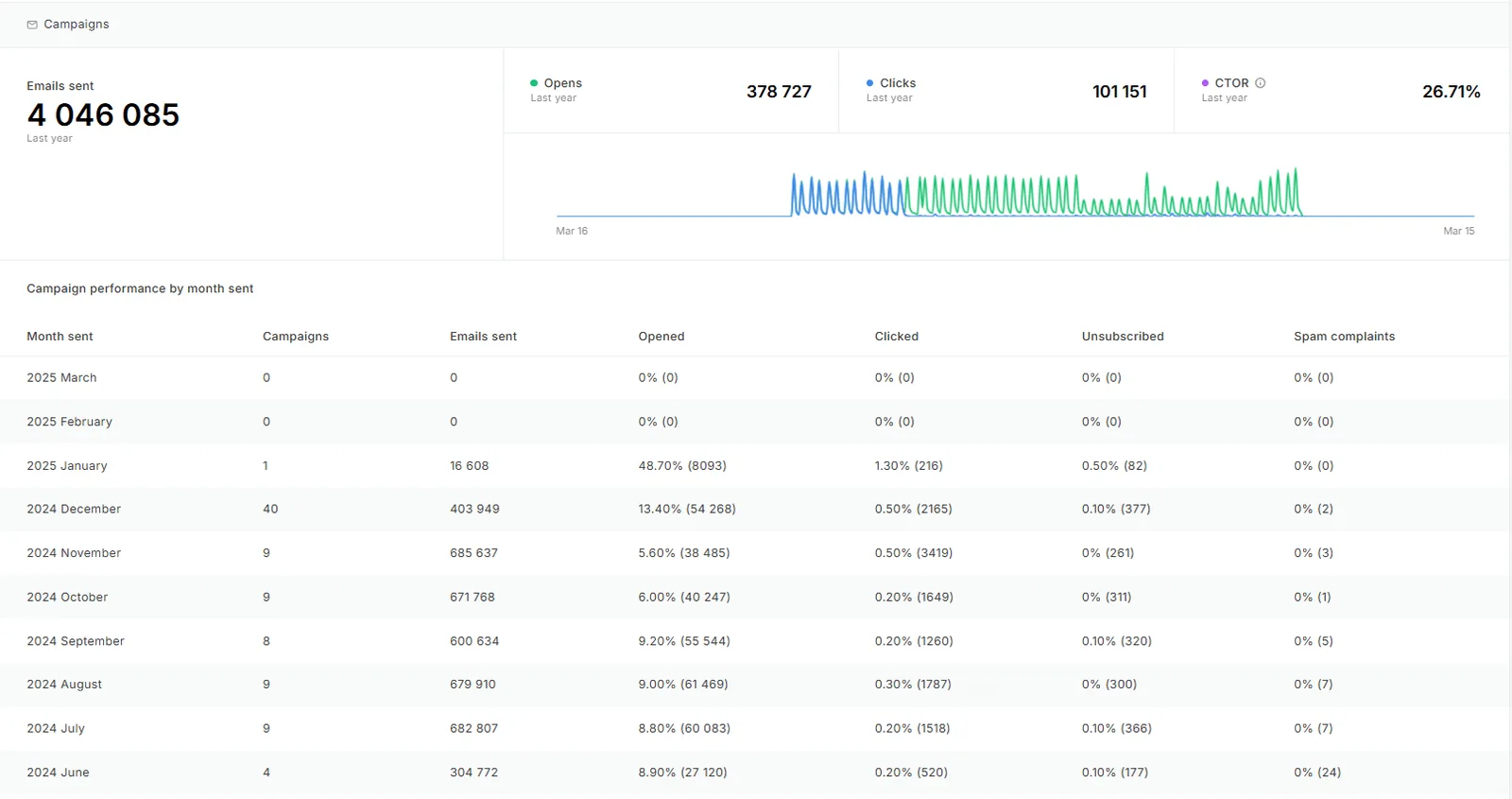
Open rates were extremely low – only 7.9%.
This is especially worrying, since industry averages are around 45–50% with a well-built email marketing strategy. Such an extremely low open rate was a clear sign that something was fundamentally wrong with the system.
So the main question was:
- Were the subject lines weak, so people didn’t open the emails?
- Or did the emails not even arrive in the recipients’ main inbox?
The next step was to find out what was behind it – and the investigation soon revealed the real problem.
The data tells the story: why weren’t the emails opened?
The table above shows campaign performance month by month in detail. According to the data, the CTOR (click-to-open rate) was 26.71%, which means many of those who opened the emails also clicked the links. This suggests the content was well made, and those who opened found the message valuable.
So the problem wasn’t the content, it was the open rate.
For months, the open rate stayed between 5–10%, extremely low compared with the industry average of 45–50%.
If it were only bad subject lines, with a database this size you would sooner or later see a change in open rates – but they stagnated for months.
So the most likely scenario was that most of the emails were landing in the spam folder, and most recipients never even saw them.
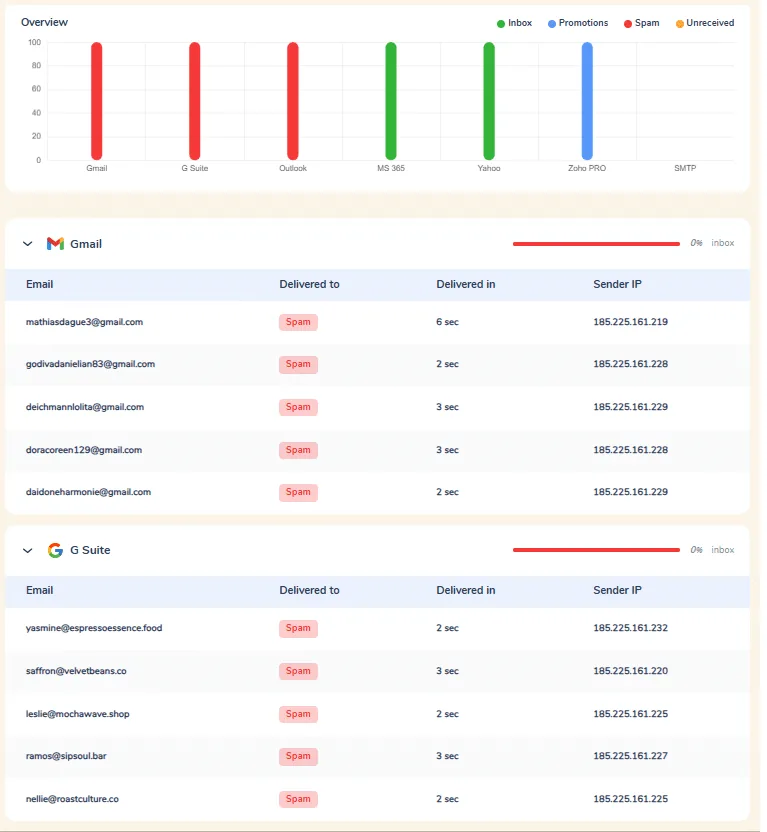
How did I confirm this? I ran a deliverability test, and the result was clear: 100% of emails sent to Gmail addresses landed in spam.
This meant the campaigns never reached readers, so no matter how well written the content or how good the offer, most users simply never saw it. The next step was to find out what caused the spam problem and how it could be fixed.
The root of the delivery problem: why didn’t the emails reach recipients?
The investigation showed that 81.31% of subscribers had a Gmail address. This clearly explained why open rates were so low: if Gmail puts the emails in spam, most users will never open them.
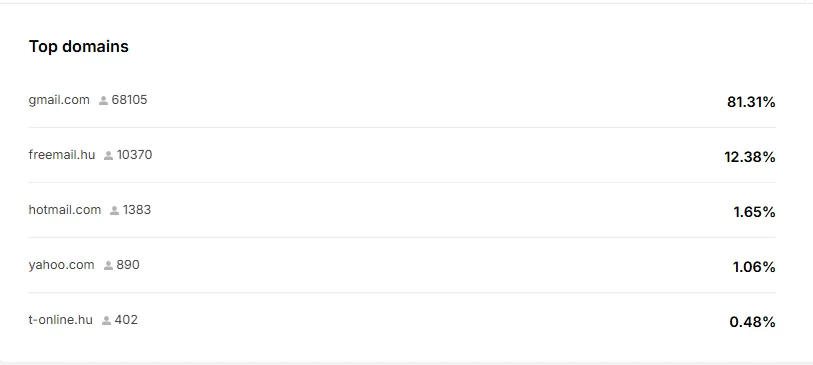
So the next question was: why had the emails been going to spam ever since the first send?
The answer pointed to a very simple, but all the more serious problem:
The role of IP reputation in email delivery
Every email is sent from an IP address that has a so-called reputation. This decides whether mailbox providers (e.g. Gmail, Outlook) treat the sender as trustworthy or as a likely spammer.
- If the IP reputation is bad, emails automatically go to spam, or may even be blocked completely.
- If the IP reputation is good, emails are more likely to arrive in the primary inbox.
Email marketing platforms offer two sending options:
1. Shared IP
Several customers of the platform use the same IP address.
The platform strictly controls the quality of the emails sent, so that the IP address keeps a good reputation.
That’s why we recommend this in most cases, as it gives safer delivery.
2. Dedicated IP
Emails are sent from your own, dedicated IP address.
This option is only recommended for high-volume senders (usually 200,000+ subscribers).
Setting up a new dedicated IP is a particularly sensitive process, because the IP first has to earn the trust of mailbox providers.
The biggest mistake: skipping IP warm-up
When setting up a new dedicated IP, strict steps must be followed so that mailbox providers don’t treat you as a spammer. This process is called IP warm-up.
If a very large volume of email is sent from a new IP right away, mailbox providers may automatically blacklist it.
- In this case, that is exactly what happened:
- The business set up a dedicated IP,
- No proper IP warm-up was done,
- A large volume of email was sent immediately,
- Mailbox providers rated this as suspicious activity,
- The result: 100% of emails went to spam.
The consequences were serious:
- The whole year’s email marketing turned into a loss.
- The MailerLite subscription (about $3,134) was a completely wasted expense.
- Email revenue for the most important period of the year (Black Friday, the Christmas season) was lost.
- Working hours were wasted on ineffective email campaigns.
To solve the problem, a completely new strategy had to be developed to repair the IP reputation and restore the effectiveness of email marketing.
How did I turn email marketing performance around?
In December I took over the account and immediately started damage control. Since fully restoring the IP reputation would have taken longer, I had to use short-term quick fixes to raise open rates.
Segmentation and gradual sending
I split the whole database into 40 smaller segments, so I could manage sends in a controlled way.
I sent the emails in smaller groups of 1,000–2,000, leaving several hours between sends.
Thanks to this, the open rate rose temporarily from 7.9% to 13.5%.
A targeted campaign for previously active subscribers
For the last December send, I only emailed people who had opened at least one email in the previous months.
This led to a dramatic increase, and that campaign reached a 48% open rate.
These temporary interventions helped limit the problem, but a long-term solution required a complete overhaul of the email marketing strategy.

New strategy: rethinking email marketing completely
MailerLite wasn’t right for a store of this size, especially because it didn’t offer advanced automation options, and in my experience its shared-IP delivery rate is weak to begin with. So I decided to replace the system completely.
- What had to change?
- Introducing a new email marketing platform (with a better delivery rate)
- Creating automated email flows (e.g. abandoned cart, loyalty program)
- Optimizing list growth
- Cleaning and reactivating the database
To choose the right platform, I needed a solution that:
- integrates with UNAS
- uses a shared IP with a good reputation
- makes it possible to add SMS marketing
- provides automatic customer profiling
I chose the TheMarketer platform, which, although a new player on the market, looked suitable thanks to its promising features.
Advantages of TheMarketer:
Amazon SES shared IP system (excellent delivery rate)
SMS marketing integration
Sign-up popups
Browser push notifications
Automated customer profiling (customer journeys)
Support for loyalty and referral programs
Possible ERP integration
Before introducing it in the client’s store, I tested the system with my own test UNAS store to make sure it worked. The basic features worked well, although there were minor problems with the email editor, which a quick update always solved.
The migration process
In January I completed the full switch to TheMarketer.
Of the 75,000 subscribers, I first imported only those who had been active in MailerLite – 16,000 people.
I then gradually started reloading the inactive subscribers and tried to reactivate them with targeted campaigns.
I am now at 22,500 active subscribers, and the number keeps growing.
These steps laid the foundation for email marketing not just to work, but to actually generate a profit.
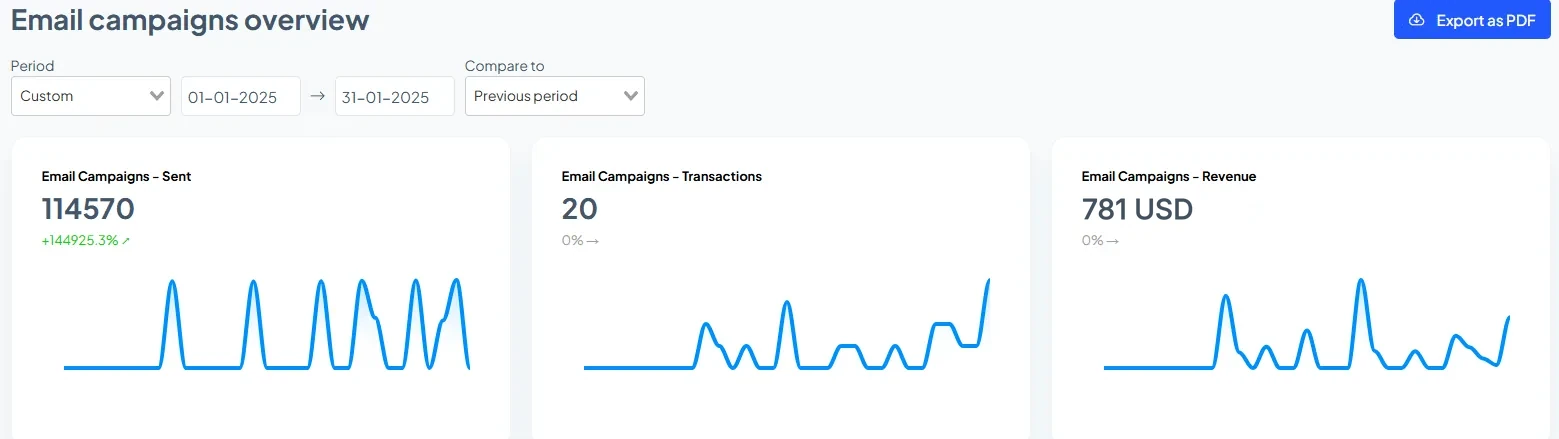
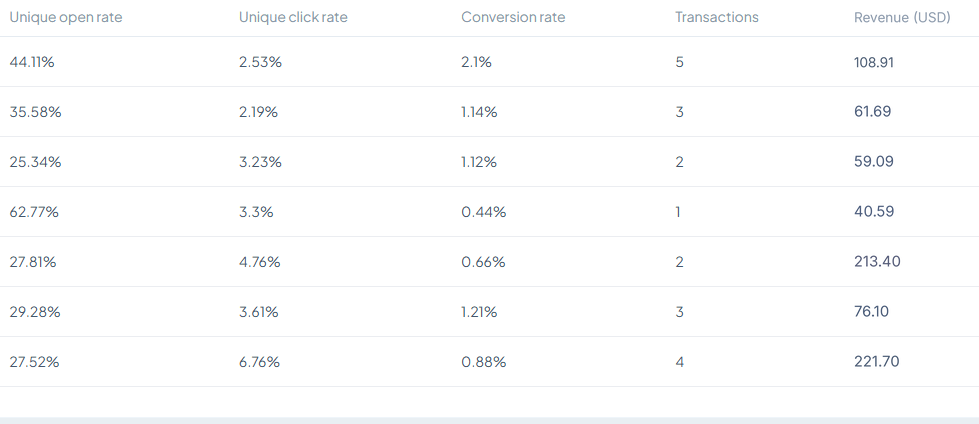
January email campaigns
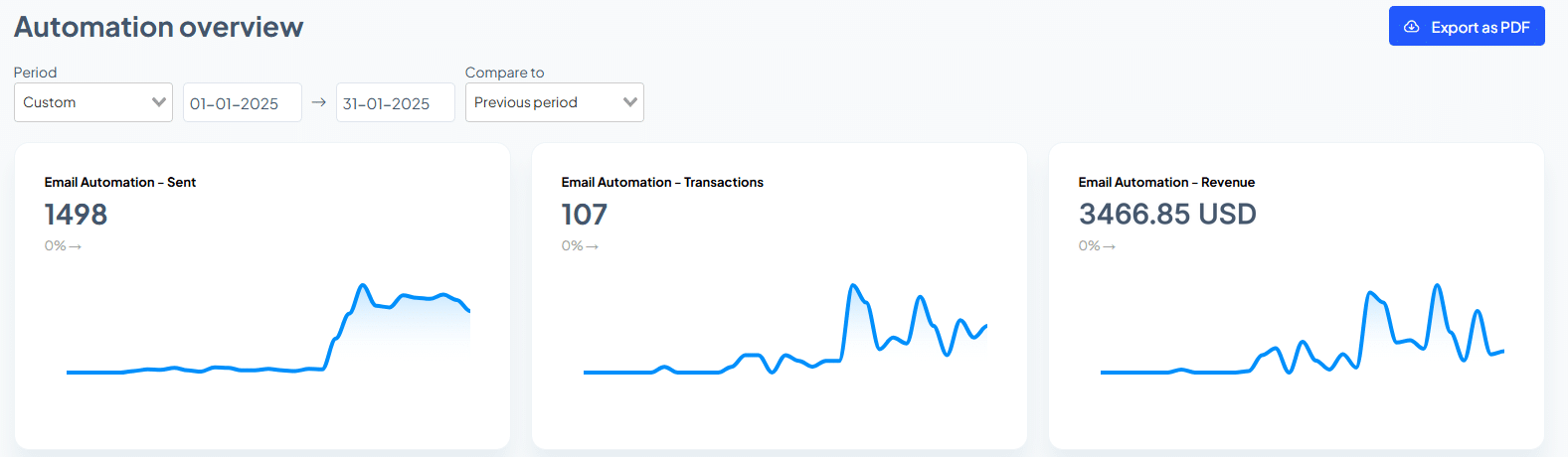
January automated flows

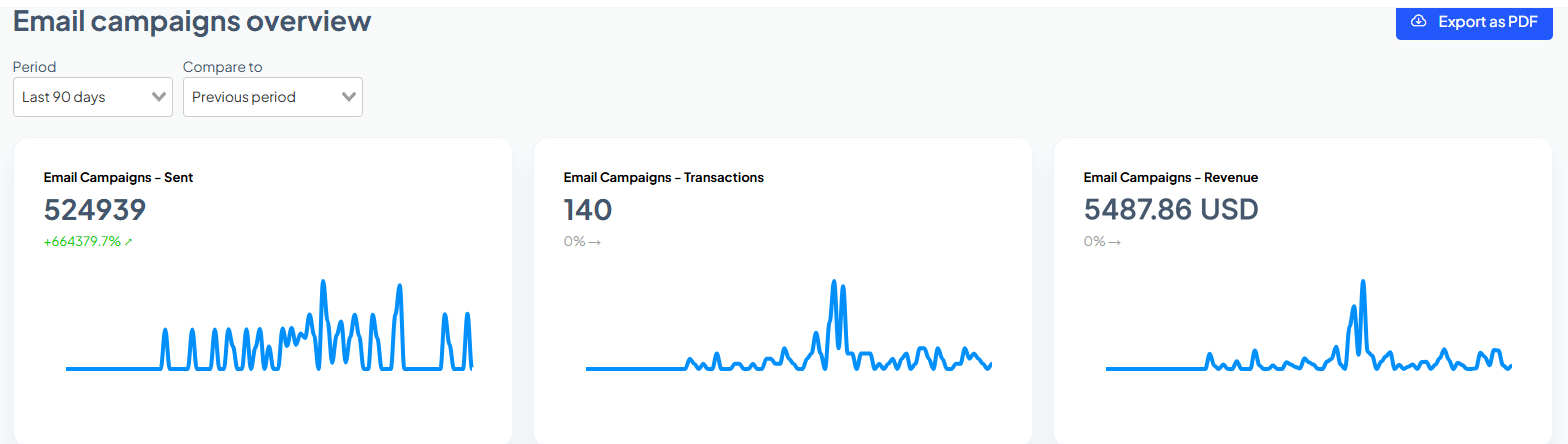
Campaign totals from January to March 18
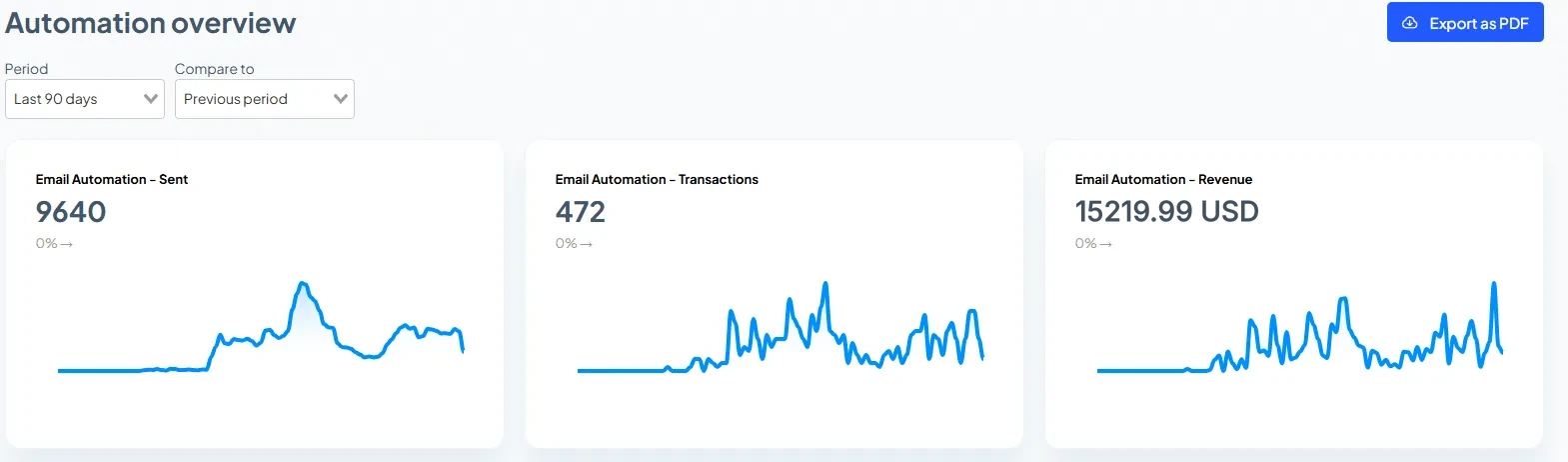
Automated flow totals from January to March 18
Lessons: how can email marketing be profitable?
Email marketing is an extremely effective tool when it is done properly. It can help win customers, drive purchases and provide a sustainable source of revenue in the long run.
But if you don’t pay attention to the details, it can easily become a source of losses.
Many businesses wrongly believe that email marketing means “we sent the newsletter” – and that’s the job done. If campaigns land in spam, open rates are low, or there is no automation, email marketing doesn’t make a profit – it just costs money.
The key lessons:
- Email marketing is only worth doing with a deliberate strategy.
- Handling spam problems is crucial – a bad IP reputation can cause losses in the thousands.
- Without automation, email marketing isn’t effective enough – you need abandoned cart emails, loyalty programs and reactivation campaigns.
- Choosing the right email marketing platform isn’t just a question of features, but also of delivery rate and reputation.
Successful email marketing doesn’t depend on the number of newsletters, but on a strategic approach and precise execution.
What can you do now?
If you’d like your email marketing reviewed, book a consultation. We’ll discuss what is worth checking and fixing.